
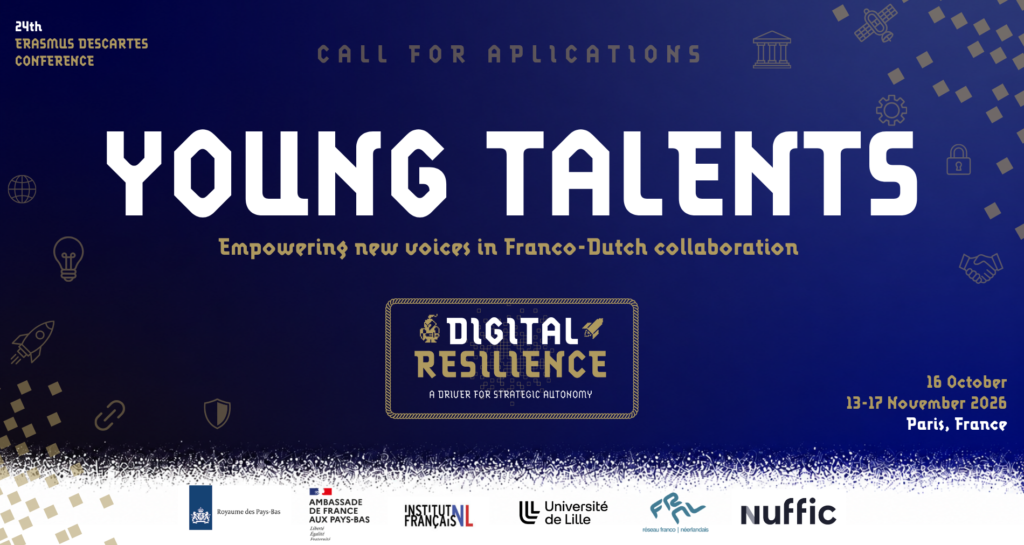
APPLICATIONS ARE DUE BY SEPTEMBER 20th 2026, AT 23:59 CET
Are you a Master’s or PhD student from France or the Netherlands with an interest in cybersecurity, digital technologies, artificial intelligence, public policy, innovation, or societal challenges linked to the digital transition?
Do you want to contribute to building a more resilient, secure and trustworthy European digital future?Would you like to collaborate in an international and interdisciplinary team and present your ideas to leading experts, policymakers, and researchers at the annual Franco-Dutch Erasmus-Descartes Conference?
Apply now for the 2026 Young Talents Programme, a unique opportunity to develop innovative ideas and concrete recommendations addressing one of today’s most strategic challenges: Europe’s digital resilience and autonomy.
Join an international team, expand your network, develop your public speaking skills, and contribute to discussions shaping the future of European digital cooperation.
This year’s theme is: “Digital resilience – A driver for strategic autonomy and societal trust” as part of the Erasmus-Descartes Conference, which will take place on Tuesday, 17 November 2026 at Campus Cyber Île-de-France in Paris.

Young Talents 2026
WHAT IS THE ERASMUS DESCARTES CONFERENCE:
The Erasme-Descartes Conference (EDC) was initiated in 2002 by the French Embassy in the Netherlands and the Dutch Embassy in France. The conference brings together over a hundred renowned French and Dutch experts from universities, research institutions, ministries, and the private sector. It fosters knowledge exchange and strengthens bilateral cooperation on key societal challenges. Each edition focuses on a central theme aligned with the European agenda and current developments in both countries. In 2026, the conference will address Digital Resilience – A driver for strategic autonomy and societal trust, exploring how France and the Netherlands can contribute to building a secure, resilient, and trustworthy European digital ecosystem. The discussions will focus on strengthening European digital sovereignty, protecting critical infrastructures, fostering innovation, and ensuring that technological progress benefits society as a whole. The 2026 edition of the EDC will take place on Tuesday 17 November in Paris, from 2:00 PM to 8:30 PM.WHAT IS THE YOUNG TALENTS EVENT
The spirit of the Young Talents Programme is captured in four key objectives:
- Fostering cross-border cooperation between France and the Netherlands
- Tackling real-world challenges by valuing the perspectives and creativity of the younger generation
- Promoting transdisciplinary collaboration across fields and areas of expertise
- Expanding participants’ professional networks through high-level events and targeted networking opportunitiesEach year, the Young Talents event, held as part of the Erasmus-Descartes Conference, brings together 8 outstanding young participants from France and the Netherlands to debate, collaborate, and co-create solutions for the future.
Their ideas, questions, and perspectives are meant to enrich the conference discussions and help shape forward-looking approaches to shared challenges.In addition to their prominent role in the conference programme, participants benefit from extensive networking opportunities with leading experts, policymakers, and fellow innovators.The 8 selected participants will be divided into two teams and will work on a specific challenge of their own choosing, in close collaboration with two expert coaches from the field. These coaches will provide guidance and support throughout the entire programme, helping the Young Talents refine their ideas and prepare for their final presentation.
While the Erasmus-Descartes Conference itself is a one-day event, the Young Talents Programme extends over a longer period. Over the course of 1.5 months, participants collaborate in two teams, working remotely through online sessions and self-organised team preparation. This is followed by a few intensive in-person working days in and around Paris, leading up to the conference.

CONTEXT
Digital technologies have become the backbone of our societies, economies, research systems, and public services. From critical infrastructures and communication networks to artificial intelligence and data management, Europe’s capacity to build secure, resilient, and trustworthy digital ecosystems has become a major strategic priority. At the same time, increasing cyber threats, technological dependencies, geopolitical tensions, and the rapid development of emerging technologies highlight the need to strengthen Europe’s digital sovereignty and resilience. Ensuring a secure digital future requires not only advanced technologies, but also strong cooperation between countries, sectors, and generations. France and the Netherlands share common ambitions in strengthening European digital capacities. Through cooperation in research, innovation, education, and cybersecurity, both countries contribute to developing a European cyberspace that protects citizens, supports competitiveness, and reinforces strategic autonomy. The 2026 Erasmus-Descartes Conference will explore the following central question: “How can we build a resilient European cyberspace and digital infrastructure that supports strategic autonomy?” Discussions will focus on three complementary perspectives:- Digital resilience as a foundation for strategic autonomy How can France and the Netherlands strengthen cooperation on digital capacities, reduce dependencies, and remain competitive in a rapidly changing technological environment?
- From strategy to action: Cybersecurity for Europe’s key systems How can European, French, and Dutch strategies be translated into concrete actions to better protect critical infrastructures and essential digital systems?
- Empowering citizens and talents to secure Europe’s digital independence How can education, skills development, and youth engagement contribute to building a resilient and trusted digital society?

CHALLENGES
Participants will work in two interdisciplinary Franco-Dutch teams to address challenges related to digital resilience, cybersecurity, strategic autonomy, and societal trust.
The challenges will be defined together with the team members and expert coaches, based on participants’ backgrounds and interests.
- Possible areas of reflection include:
strengthening European digital independence while maintaining openness and innovation; - securing critical infrastructures and essential digital services;
- building trust between citizens, institutions, and technologies;
- developing the skills and talents needed for Europe’s digital future.

CONFERENCE & PROGRAMME
The Conference
The conference will be based on discussions between experts, scientists, stakeholders, and high-level decision makers.
Central to this conference are exchanges between high-level speakers on developments on a political level between France, the Netherlands, and Europe. Other round table discussion will shine a light upon research and innovation, as well as the investments and training of the next generations. s.
Alongside the various experts, the Erasmus-Descartes Conference gives the floor to the Young Talents to pitch their findings, recommendations and solutions, and discuss them with the participants. They will prepare their pitches in advance with two devoted coaches during the month prior to the conference, including the 3 days where they will meet and work in person.
You as a Young Talent
To prepare your contribution to the Erasmus-Descartes Conference on Tuesday, 17 November 2026, you will participate in several preparatory steps.
During the online kick-off meeting, you and the other selected participants (4 from France and 4 from the Netherlands) will meet your teammates and receive more information about the programme.
Based on your expertise and interests, you will form two interdisciplinary teams. Each team will work with expert coaches who will support you throughout the process, helping you explore ideas, structure your recommendations, and prepare your final presentation.
Between the kick-off and the in-person sessions, your team will collaborate remotely and organise online working sessions with the support of the coaches.
From Friday 13 November to Wednesday 18 November 2026, all participants will gather in Paris for an intensive Young Talents programme.
During these days, you will:
- participate in working sessions;
- develop your ideas and recommendations;
- receive coaching and pitch training;
- prepare your contribution to the Erasmus-Descartes Conference.
On Tuesday 17 November, each team will present its ideas during the conference and exchange with experts, researchers, policymakers, and professionals from France and the Netherlands.
The programme will end on Wednesday 18 November.
Please note: participants will receive a certificate of attendance. PhD candidates in the Netherlands may be able to use this certificate to validate ECTS credits at their home institution.

PRELIMINARY PROGRAMME
| Date | Programme |
|---|---|
|
16 October | 10:00-12:00 |
Kick-off meeting (online):
|
|
16 October – 13 November |
Contact with team members and coaches, preparing the challenge per team – each team decides how to manage its time. |
|
13 November |
Morning : Travel to Paris |
|
13 – 16 November |
Working sessions: work on the challenges, in group preparation, coaching, feedback sessions and pitch training |
|
17 November |
Morning: Fine tune pitches / train / free time |
|
18 November |
Travel back home |

PRACTICAL INFORMATION
Organizers: The Young Talents event is organized by the Embassy of France in the Netherlands, the Institut français NL, the Embassy of the Netherlands in France, the French-Dutch Network for Research and Higher Education, Nuffic (the Dutch organization for internationalization in education), and the University of Lille.
Partners: Collège Néerlandais Paris – to be confirmed
When: October 16 (online kick-off), and November 13 to 18 (on-site in France), including participation in the Erasmus-Descartes Conference on Tuesday 17 November 2026 in Paris.
For whom: MA,MSc, PDEng, and PhD students from France and the Netherlands, aged between 20 and 35 years old, with a good working knowledge of English. International students enrolled in French or Dutch institutions are also welcome to apply.
We are looking for students from diverse academic backgrounds related to digital resilience and cybersecurity, including but not limited to:
- Cybersecurity / Computer Science
- Artificial Intelligence / Data Science
- Engineering / Digital Technologies
- European Studies / International Relations
- Public Policy / Governance
- Law / Digital Regulation
- Social Sciences / Ethics of Technology
- Innovation / Entrepreneurship
- Public administration
Students from other disciplines who feel they can meaningfully contribute to building a secure, resilient, and trustworthy European digital future are also warmly encouraged to apply.
Language: The working sessions between Young Talents as well as the Erasmus-Descartes conference will be entirely in English.
Costs: The organizers will cover the costs of transportation (travel between the Netherlands and France + public transport on-site) and meals (breakfast, lunch and dinner). They will also arrange accommodation (five nights). You are responsible for the costs of any other expenses yourselves. The participation in the Young Talents event does not involve any initial expenses for the participants.
Participation: All 8 selected participants will attend both the online meeting and the physical 5-day session in Paris. Participation in the full programme is mandatory. Any unjustified failure (absenteeism, inappropriate behavior) will lead to exclusion from further participation in the Young Talents event.

-
Step 1
Fill in the application form. You will be asked to submit your CV (Pdf / jpeg / png) and 5 short texts answering the following questions.
-
Step 2
Preselection - As soon as the deadline has passed, a first selection process will be made. You will receive an email with the decision.
-
Step 3
If you are preselected, you will be invited to participate in a short online meeting on Monday 28 September 2026, between 1:30 PM and 3:30 PM (CET). You will have the possibility to choose a timeslot of 5min out of a list. You will be asked to pitch in 3 minutes your motivation and interest in why you should participate in the Young Talents event.
-
Step 4
Final selection. You will receive via mail the final decision. If you are selected, you will receive more information about the next steps in order to prepare your participation.
HOW TO APPLY
Step 1 – 5 questions- Describe your current or past studies, research, professional experience, or other activities related to digital resilience, cybersecurity, artificial intelligence, digital technologies, governance, or societal challenges linked to the digital transition. Please explain your role and contribution. (approx. 200 words)
- Explain your motivation to participate in the Young Talents Programme and describe how your background, skills, or perspective could contribute to a multidisciplinary and multicultural Franco-Dutch team. (approx. 200 words)
- Share your initial ideas on how Europe can strengthen digital resilience while supporting strategic autonomy and societal trust and how France and the Netherlands could have a front runner role. Which challenges or opportunities would you like to explore during the programme? (approx. 200 words)
- Describe the role you could play within an international team of four students. For example: Are you more of a facilitator, a leader, a technical expert, a creative thinker, a coordinator, or someone who connects different disciplines?
- Which aspect of digital resilience interests you the most (e.g. cybersecurity, AI, digital sovereignty, ethics, regulation, education, citizen trust, innovation, etc.) and why? (approx. 100 words)
APPLICATIONS ARE DUE BY SEPTEMBER 20th 2026, AT 23:59 CET

